GEOD
union
Combining several curves into a single one with the union command
The union command is used to group several curves into a single one.
It is sometimes useful to combine several curves into a new single curve. This is possible with the union command, which is used with the following syntax:
  union name1 name2 ... namen
  end
where name1, name2, ..., namen are the names of n curves. See also the section on the name subcommand.
For example, if one wishes to construct a new curve resulting from the union of the two curves named a and b in figure 1 below, one writes:
  union a b
  end
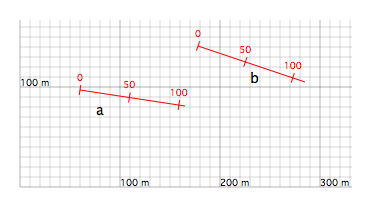
Figure 1 : Two curves named a and b, graduated by means of a graduate instruction.
After hiding the two original curves, the result obtained is shown in figure 2.
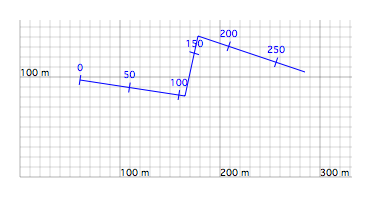
Figure 2 : The blue line is formed by the union of the two curves a and b.
The union of curves depends on their orientation. If, for example, one is in the case shown in figure 3, where curve b is oriented in the opposite direction to curve a,
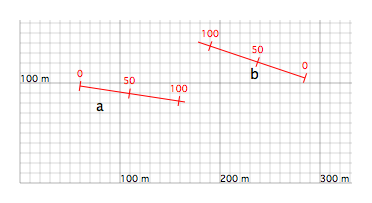
Figure 3 : Case in which the initial curves do not have the same orientation: curve a is directed from left to right, whereas curve b is directed from right to left.
then a different curve is obtained, as shown in figure 4.
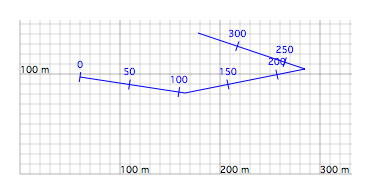
Figure 4 : Curve obtained by the union of curves a and b from figure 3.
However, if one wishes to obtain the same result as in figure 2, the instruction must be rewritten as follows:
  union a -b
  end
by placing a - sign before the name of the curve to be reversed. In this way, the - sign tells the union command to use that curve in the opposite direction.
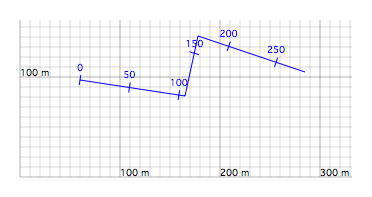
Figure 5 : Curve produced by the instruction union a -b from curves a and b in figure 3. The result is the same as in figure 2.
When constructing a geological cross-section, the union command makes it possible to define new bed boundaries. This is especially useful when the cross-section contains blind synsedimentary faults that do not intersect the surface.
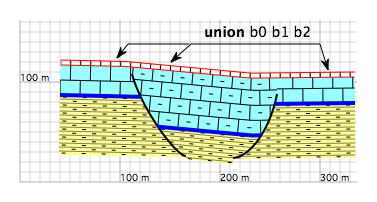
Figure 6 : Geological cross-section with synsedimentary faults. The base of the post-tectonic strata is constructed using a union command, by combining three bed boundaries named b0, b1, and b2, located respectively at the top of the left, central, and right compartments. The master curves used for the cross-section are drawn as thick blue lines.
When using the union command, two other GEOD instructions are often useful:
- first, the initial curves used for the union usually need to be erased. For this, one uses the hidden instruction.
- second, the curve produced by the union command often contains loops and self-crossing parts. To remove them, one uses the nocrossing instruction.