GEOD
Computer-assisted drawing of geological cross-sections
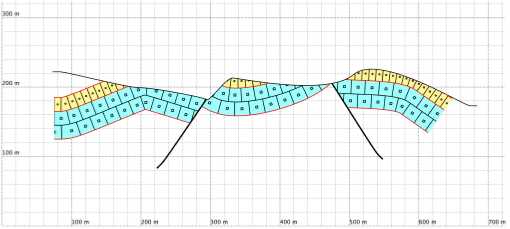
Interface and presentation image of the GEOD software.
GEOD is a software package designed for the computer-assisted drawing of geological cross-sections. It provides a set of specific features that are not available in conventional drawing software and is intended for geologists who need a precise and efficient way to construct, test and export geological sections.
The software combines vector drawing, geological parameterization, and script-based construction. It is therefore both a drawing tool and a 2D geological modeling environment.
General presentation
Unlike standard drawing software, GEOD is specifically designed for geological work. It uses concepts and parameters that are directly meaningful to geologists, such as:
- dip,
- polarity,
- thickness,
- extent,
- age,
- layer boundaries,
- faults and offsets.
One of the main strengths of the software is that lithological patterns are drawn while respecting the actual geometry of the geological layers. This makes it possible to produce cross-sections that are both visually clear and geologically coherent.
Script-based operation
GEOD is controlled through a scripting system. The construction of a geological cross-section is performed by entering instructions in a text window located next to the graphical view of the section.
This approach offers several advantages:
- precise control of the geometry,
- reproducibility of the work,
- easy correction and updating,
- rapid testing of variants,
- compatibility with GIS tools and databases.
Because the section is described by commands rather than only by manual drawing, the user can modify one or two parameters and immediately generate a new version of the cross-section.
A vector drawing software
GEOD is a vector graphics software package. It uses simple and robust geometric objects to construct geological sections, especially:
- polygonal lines,
- Bézier curves,
- translated curves,
- constant-thickness offset curves,
- boxes,
- masks,
- text objects.
This vector-based approach ensures clean and scalable drawings, suitable both for teaching and for publication-quality figures.
A 2D geological modeler
GEOD is not only a drawing tool. It is also a 2D geological modeler capable of reconstructing a complete geological cross-section from a limited set of field constraints.
For example, a section may be generated from only a few pieces of information such as:
- dip measurements at selected points,
- unit thicknesses,
- geometric relationships between formations,
- fault traces or structural markers.
This makes the software particularly useful for exploring different geological interpretations. By adjusting a small number of parameters, the user can rapidly generate several alternative cross-sections from the same dataset.
GEOD is therefore especially well suited for producing serial cross-sections and for comparing multiple structural scenarios.
Output format
Geological cross-sections produced with GEOD are saved in vector PDF format.
This has an important practical advantage: the figures can later be reworked, completed or refined in a vector graphics editor such as Adobe Illustrator, while keeping high graphical quality.
Lithological patterns
GEOD includes a wide range of instructions for drawing lithological patterns. These patterns are stored as vector objects, and their properties can be customized in detail.
Among the adjustable properties are:
- size,
- line thickness,
- spacing,
- color,
- repetition style.
Because of this flexibility, the number of patterns that can be created is virtually unlimited. The software is also distributed with a small library of ready-to-use patterns.
Animation capabilities
GEOD also offers animation functions. It is possible to make the position or dip of a point vary through time and to visualize the resulting deformation or evolution of the cross-section.
These animations can be saved as QuickTime sequences, which makes the software useful not only for static drawing but also for dynamic illustration of geological evolution.
The scripting language
The software uses a simple scripting language that makes it possible to:
- insert basic geometric objects needed to build the cross-section,
- define fixed variables,
- define variables that change through time,
- create value arrays,
- insert comments,
- include one script inside another.
The available objects may include points, lines, Bézier curves, translated curves, offset curves of constant thickness, boxes, texts, logs, lithological patterns, fill patterns, and masks.
The script editor uses syntax coloring so that words are displayed differently according to their meaning. This improves readability and makes scripts easier to write, understand and debug.
Main advantages of GEOD
- software specifically designed for geological cross-sections,
- direct use of geological concepts and parameters,
- precise construction through scripting,
- vector output suitable for publication,
- customizable lithological patterns,
- rapid generation of alternative structural models,
- compatibility with GIS data and workflows,
- animation capabilities for dynamic visualization.
Platforms
GEOD has been developed for MacOS X and Windows.
Note that the Windows version is currently more limited than the MacOS X version, and some important functions may be missing.
Typical uses
GEOD can be used in a variety of contexts:
- teaching structural geology and geological mapping,
- preparing geological reports,
- drawing publication figures,
- testing alternative subsurface geometries,
- producing serial cross-sections,
- illustrating the evolution of structures through time.
Download
GEOD is freeware and may be distributed freely.
Download the software here: GEOD (MacOS version), GEOD (Windows version).